So, having seen as many horror films as I have and proudly proclaiming to all that will listen that I am a huge horror buff, a question I get asked a lot is pretty obvious - "What is your favorite horror film?"
For a while, I honestly didn't know. My mind would go blank at hearing this question and I'm sure my credibility as a true horror fan seriously came into question. If you love something so much, how could you not have a favorite?
Other favorites are easy - favorite color: green, favorite time of the year: autumn - but this one required a little bit more thinking. The horror genre itself is actually pretty complex, with lots of subgenres from which to choose. If there isn't a definitive list of subgenres out there, here's some that I can think of off the top of my head:
Slashers (Halloween
 , Friday the 13th
 )
)Creature features (Tremors
 , Ghoulies
 )
)Vampires
Werewolves
Supernatural
Zombies
Man vs. Beast (Anaconda
 , Deep Blue Sea
 , Primeval
 )
)Anthologies (Creepshow
 , Trick 'R' Treat
 )
)Serial killer (different from slasher)
So then I had to break this list down into the stuff that I like. I freaking love zombie movies, and they're my favorite out of the classic triumvirate (Vampires, Werewolves, Zombies - most people would say Frankenstein here but there aren't enough Frankenstein monster movies out there for me to include it in my triumvirate), but sometimes you want to see more than just slow-walking dead guys eating somebody's intestines. Creature features and killer animals are okay, but usually high on the hokey meter. Slashers and serial killers usually contain the most cliches and are hardly ever that original. Again, there aren't enough anthologies out there really to have a favorite, although Trick 'R' Treat was freaking sweet.
That leaves supernatural. And I thought, yes! I see it now, because that is totally my favorite genre. Stories of hauntings and stuff has always interested me, and ghost movies are the ones that ALWAYS make me squirm in my seat like a little girl when I watch them, if they're effective.
So once I decided that I loved supernatural horror, my favorite became easy. It's an absolute classic haunted house film from 1982 that I believe still holds up well against any modern horror film. What is it? Have you guessed?
POLTERGEIST.
This movie just kicks ass. No doubt about it. You wanna talk haunted house? Here you've got poltergeists, which I like to think of as the "really pissed off ghosts." They're the ones that like to move stuff around and really cause a disturbance, which there are plenty of in this film.
But this movie is also very different from other haunted house movies. It doesn't take place in a dark and creepy castle or mansion, and it's not about finding out how someone died or something, it's just that there are evil spirits in the house and we gotta get rid of them. Plus this movie can be funny as hell at parts, which I think is so clever. Tobe Hooper (director) manages to mix in some very subtle funny moments with some not-so-subtle creepy moments.
 The film starts out rather oddly for a horror film, with "The Star Spangled Banner" playing loudly over the credits. We soon find out it is coming from the TV (stations used to play the song when they signed off), which has been left on while everyone in the house is asleep. Little Carol Anne wakes up and discovers "the TV people," which she can hear coming from the static. This is a creepy little scene itself, with Carol Anne smiling while she talks to the TV people. I think it's because of her Village of the Damned reminiscent hair and creepy little girl's voice. But, later scenes show us that this is your typical happy suburban family with three cute kids and two loving parents. How could anything bad happen to them?
When Carol Anne utters the famous line "They're here!", that's when the crazy shit happens, starting the next morning at breakfast, which is my favorite scene of the whole movie. The bottom of Robbie's milk glass explodes and his utensils go all bendy, but the best part is when the mother, JoBeth Williams, pushes in all the dining room chairs, walks into the kitchen with the table out of frame, and the next second she turns around, all the chairs are stacked up on the table. See now, this is what makes for some scary and unexpected stuff. Why? Because it's happening during the day. They're not hearing voices or banging noises or footsteps on a dark and stormy night, which is when you expect that stuff to happen. Ghost movies are all about expecting the unexpected, and Poltergeist takes the unexpected to a whole new level.
Human-eating trees, little girls that disappear into closets, and gross hallucinations of people tearing the flesh off their face (probably my second favorite scene, with the meat sliding across the counter - yeesh!) all make for a movie that starts off creepy and never lets up, often escalating to strange new levels at points. When the ghost hunters show up to help the family rescue Carol Anne, the movie lightens up a bit again like in the beginning - I love the part where they're all talking at the table. Dr. Lesh says that determining that their house is actually haunted is not very easy - just as the coffee pot slides across the table on its own.
Another great thing about this movie? When Dr. Lesh brings some help in the form of Zelda Rubinstein as Tangina. Nuff said. Oh wait, except for, "This house is clean!" Haha.

 or The Others
 , but it's still creepy and probably ten times more entertaining. The special FX are not as primitive as you might think, and I believe they still are effective after all these years. The greatest special FX is of course at the end.
Carol Anne is rescued from TVPeopleLand and little Tangina says all is well again.
Psyche!
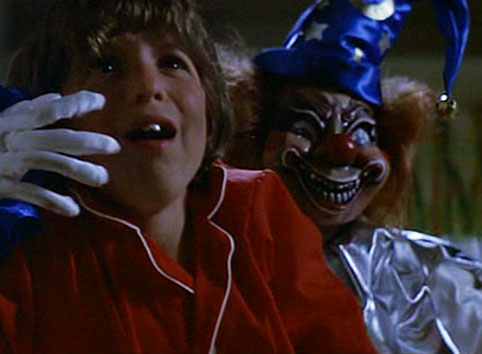 The TV people are still around and now they're uber-pissed! But first, they're going to scare the shit out of you via your already scary toy - the clown doll. Now, we saw this eerie little bastard at the beginning of the film when Robbie got scared and threw a jacket over him. Nothing happened there, and the audience thought they were safe. Oh no. First, nothing's really supposed to happen because the disturbances are over. Then there's a faint noise, and when Robbie looks at the chair where the clown was sitting, it has disappeared. Crap. Then the kid actually has the cajones to look under the bed! I would've been screaming for mama at this point. So of course the clown attacks, giving us yet another reason we didn't need to think that clowns are scary.
Then all hell breaks loose and the mother confronts this thing:

I mean, what the hell is that? And it growls at her like a lion, too. Anyway, the closet tries to swallow the kids again, coffins and skeletons come out of the ground, and the family finally gets the f*%$ out of the house before it implodes on itself. And when they go to the hotel the dad pushes the TV out of the room. Awesome ending to an awesome movie. I never get tired of it and I hope I never will. It's the subtleties of classic haunted house films mixed in with the amped-up manifestations of the poltergeists (with great 80s FX) that makes this movie a special classic.
The film is also fairly accurate according to paranormal experts. Carol Anne communicating through the TV static is the now more well known phenomenon of EVP. The word poltergeist comes from the German for "noisy ghost," so that covers the ghosts stacking the chairs and throwing all the stuff around in the kids' room. They also might physically assault people in the house and cause electrical disturbances, all present in the film. So yeah, all the crazy stuff that happens toward the end is not exactly well documented in the real world, but the basic things that usually identify a poltergeist as opposed to a regular haunting are all there.
So there you have it: my favorite horror film of all time, Poltergeist! And it only made No. 80 on Bravo's list of the 100 Scariest Movie Moments. I call bullshit. Here's a YouTube video of it: 100 Scariest Movie Moments - 80 - Poltergeist.
And yes, I know a remake is possibly in the works. I don't want to talk about it.


 fame playing Sylvia, and an adaptation of
  ) there is still no definitive answer how this crime could have happened. Gertrude Baniszewski was found by many to be sane at the time of the crime, but there is no psychological evaluation out there to read that says, "This is why I hurt Sylvia." And with the major perpetrators of the crime long dead, this question will never be answered. We can speculate all we want and we can blame it on the family's poverty and anger at their life situation, but that's just not good enough for me. Sylvia deserves more than that.
 , both stories are based on the legend of the Sawney Bean family (an interesting read - check out the story
  can be described as a gore-fest. It's a fairly quick read, but there is so much blood and guts and incestuous cave-people sex packed into this tiny novel that it is not something you'll forget soon. We even get a recipe on how to cook human flesh. Nice. But it's totally awesome. Gorehounds like me love this shit - if it makes you do that dramatic thing of putting her hand to your mouth in shock, then I'd say the story is a success. Well done, Jack. (There's also an equally disgusting sequel to
  .)
.) . Whuh? This is by the same guy?
  . Holy crap. Just look at the picture over there. This was about a couple who kidnap a pregnant woman on her way to an abortion clinic. They want the baby so they decide to hold her hostage in their basement until she gives birth - there's some sadomasochistic torture and other fun stuff here, but again, it's another example of this writer seemingly not knowing in what genre he wants to be. It's good that he's got such range, but you probably wouldn't think much of this author until you read
 . Great story with some unforgettable characters. Ray Pye is this nihilistic, egotistic, evil person who shoots two girls he sees in the woods because he thinks they are lesbians. He drags his two "friends" into the act as well, and manages to not get caught for the attack, even though one local cop is sure that he committed the crime. The novel is a rather slow burn as the reader gets to know Ray and the other characters around him. The big question throughout the novel though is, Where is this going? How is it going to end? Is Ray just going to get caught? Will there be a big shoot-out or something? These characters have gotten themselves into some serious stuff and with Ketchum, you're not really sure what to expect.
 as well, but it didn't really affect me as much as it did others. Perhaps I have no heart. I'm very curious about several other Ketchum novels, but I find he's a little hard to come by at chain bookstores. Go for Amazon.com or a used bookstore to find some of his more obscure novels.
 remake is perhaps a better film cinematically in my belief, however, I still contend that
  is the best because it was much more successful and popular and appealed to a much wider audience.
 is another Wes Craven classic and was in fact his very first feature film. He had a very intriguing story inspired by an Ingmar Bergman film (
 ), but perhaps not all the resources at the time to make the best adaptation of his vision. The resulting film was a shocking and violent gore-fest that put the country in a tizzy. People went absolutely nuts over this movie. It received an X rating when first sent to the ratings board and was banned in several countries for many years. Roger Ebert, however, liked the movie (yet he railed against
  - I don't get it), and over the years it has gained more credibility and admiration and is now considered a classic.
 and
and  . Going into the movie, I was most excited to see the actor playing Krug and if he could be as good as David Hess. Garrett Dillahunt does not disappoint as Krug. He's apparently played a bad guy before and it seems to be his forte. A mustache and beard and some black hair and totally looks the part of a bad-ass - but thankfully, not a bad-ass that you sort of like, which would have ruined the movie. He is a bad guy that you never like right from the start. He taunts the policeman in the beginning as the man is dying, he treats his son horribly, it's his decision not to let the girls go when they have a chance, he stabs Paige, he rapes Mari, and he shoots Mari. He has no respect for human life, therefore the audience has no desire to see him live. I would love to see this actor in more stuff.
 , THHE was the perfect film for him to take on (after THHE, Aja directed
  , another thrilling and creepy movie - the jaw rip scene is probably the most horrific thing I've ever seen).
 just came out not too long ago, and it sucked. It sucked really hard.
  was probably the biggest suck of all remakes. No, wait, that award goes to
  ... which was actually a remake of an Asian horror movie, which is a category all it's own. Let's stick to remakes of classic American films.
 -man himself, Tobe Hooper, you have to admit that the film is seriously flawed. It's a low-budget movie from the 70s with actors that are still unknown to this day. Yes, it has some creepy and gross-out moments (Grandpa sucking the blood off of Marilyn Burns finger?????? So wrong.) and the whole concept of this whacked-out cannibal family and a giant 'tard with a chainsaw is incredibly disturbing, but it doesn't really hold up well over time.
 ), with great set design and locations. The Hewitt house, its basement, the slaughterhouse, the crazy neighbors' trailer... they all give you a great sense of time and place in the context of the film. Set design was especially helpful in getting the real feel of the film. The whole movie is just DIRTY. Dirty characters, dirty deeds, dirty houses. The people in the movie are sweaty and dirty like they haven't showered in a few weeks. The house and other sets are dirty, cluttered, dripping with water, covered in dried blood - ook! I just wanted to jump into the movie and hose down everybody and everything I could touch.